
India is gearing up to introduce a six-member monetary policy committee that would vote on interest rates.

With average returns of 18 per cent over the past year, listed real estate investment trusts (Reits) have clearly outperformed both the Nifty Realty index and the Sensex. Over the same period, Nifty Realty fell 15.5 per cent, while the benchmark index was largely unchanged. Steady office leasing, the Securities and Exchange Board of India's (Sebi's) decision to reclassify Reits as equity instruments, and ongoing portfolio expansion have strengthened the sector's appeal.

RBI sees marginal improvement in economic growth to 5-6%.

The Reserve Bank of India (RBI) on Friday kept the key repo rate unchanged at 4 per cent in view of rising inflation and faint signs of economic growth amid the gradual lifting of coronavirus related countrywide lockdown.

This was the near-unanimous replies of 10 market participants.

FDs are not advisable for long-term wealth creation as their post-inflation, post-tax returns are not very attractive.

RBI has held its short-term lending (repo) rates unchanged at eight per cent since April 2012.

The Reserve Bank's rate-setting panel, Monetary Policy Committee (MPC), began its three-day deliberations on Wednesday amid expectations of a status quo on benchmark rate mainly on account of uncertainty over the impact of the second wave of COVID-19 pandemic. Moreover, the fears of firming inflation may also refrain the MPC from tinkering with the interest rate in its bi-monthly monetary policy outcome to be announced on Friday. The RBI had kept key interest rates unchanged at the last MPC meeting held in April.

RBI, in its first bi-monthly monetary policy statement, left the short-term lending rate, or repo rate, unchanged at 8 per cent and the cash reserve ratio static at 4 per cent.

Market breadth depicted gains with 1,476 advances over 1,403 declines on the BSE. 140 stocks remained unchanged.

Adopting a wait- and-watch approach ahead of US Fed meeting

Opinions vary, but fund managers remain bullish.

P K Mishra, a retired IAS officer of the Gujarat cadre, is currently serving as the principal secretary to the prime minister.

The Reserve Bank of India (RBI) on Friday decided to leave the benchmark interest rate unchanged at 4 per cent but maintained an accommodative stance, implying rate cuts in the future if need arises to support the economy hit by the Covid-19 pandemic.

Review your family emergency fund and replenish it if needed. Revisit financial goals to see if there is any change in timeline or the corpus required.

Exactly a fortnight ahead of the Reserve Bank of India's (RBI's) next monetary policy review, a key market indicator of interest rates - the overnight indexed swap (OIS) - suggests that the central bank may tighten policy by 35 basis points and then refrain from further rate hikes. RBI Deputy Governor Michael Patra recently described the OIS as the primary instrument for hedging interest rate risk in India. The six-member Monetary Policy Committee (MPC) of the RBI will meet on December 5-7.

'Banks are being encouraged to lend instead of parking their resources with the RBI and earn risk-free interest income,' points out Tamal Bandyopadhyay.
It has already cut the rate three times this year to loosen credit and boost slowing growth in Asia's third-largest economy.
With the revision, term deposit between 180-210 days less than Rs 1 crore (Rs 10 million) would now earn 7 per cent against existing 6.80 per cent, SBI said in a statement.

The repo rate could be reduced by 50 bps in the current year.

The returns from liquid funds, currently, look better than what savings accounts of leading banks are offering, points out Sarbajeet K Sen.

The repo or short term lending rate remains unchanged at 6.75 per cent and the reverse repo rate at 7.75 per cent.

BofA-ML said the liquidity deficit is running higher than the forecasts because the RBI has suspended its bond buybacks or open market operations.

A day after the RBI raised the benchmark lending rate by 35 basis points, Kotak Mahindra Bank Managing Director Uday Kotak on Thursday said the central bank may go for one more rate hike to bring inflation below its upper tolerance level of 6 per cent. Yesterday, the RBI indicated that it wants inflation to be within the band first and then move towards the target of 4 per cent, Kotak said at the CII Global Economic Policy Summit 2022. "My sense is that there could be one more rate hike and that may be the time for thinking about a pivot, but we got to watch very closely the data, and maybe around 6.5 per cent as it looks today, subject to what happens to the world, subject to what happens to oil, subject to what happens to many other things," he said.
The repo rate has been unchanged since January, when the RBI increased it by a quarter percentage point.

The repo rate has been left unchanged at 4 per cent, Governor Shaktikanta Das said while announcing the decisions taken by the central bank's MPC.
A repo rate hike may hurt growth far more than it will help deal with an inflation rate that is already dropping.

Expressing disappointment over RBI's decision to hike the key policy rate, real estate developers said this would lead to increase in finance cost and also affect housing demand during the festive season.

A host of lenders, including State Bank of India, IDBI Bank, Indian Bank and Andhra Bank, have lined up meetings of their asset-liability committees this week, to review their lending and deposit rates.
Nearly all the 43 economists surveyed over the past week expect the RBI to leave its key repo rate on hold at 8 per cent.

The RBI's next policy review is set for Sept. 29.

Wholesale inflation fell to a 4-month low of 1.31 per cent in August due to a decline in prices of vegetables and fuel, even though onion and potato prices spiked, according to official data released on Tuesday. Wholesale price index-based inflation fell for the second straight month in August after it hit a high of 3.43 per cent in May. Inflation in July was 2.04 per cent. In August last year, WPI inflation was (-) 0.46 per cent.
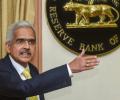
Financial markets are under stress and require steps by the central bank for market stability and revival of economic growth, he said while announcing the decisions taken by the Monetary Policy Committee in Mumbai.

"The Monetary Policy Committee recognises that there is monetary policy space for future action. However, given the evolving growth-inflation dynamics, the MPC felt it appropriate to take a pause at this juncture," the RBI said in its fifth bi-monthly monetary policy for this fiscal.
The stock markets, which had opened in the green on rate cut hopes, tumbled after the monetary policy announcement.

The Reserve Bank of India unexpectedly raised its policy interest rate on Tuesday by 25 basis points (bps) but said that if consumer price inflation eases as projected, it does not foresee further near-term tightening.

Investors watch out for cues from the on-going winter session of the Parliament.
Finance Minister P Chidambaram on Monday said he does not expect the Reserve Bank of India to hike interest rates in the July review of the monetary policy

The industry urged the central bank to consider a rate even before the next monetary policy review on July 30.

Das said banks have passed only 0.29 per cent in rate cuts to their borrowers as against 0.75 per cent cuts in interest rates by the Reserve Bank till June.
